
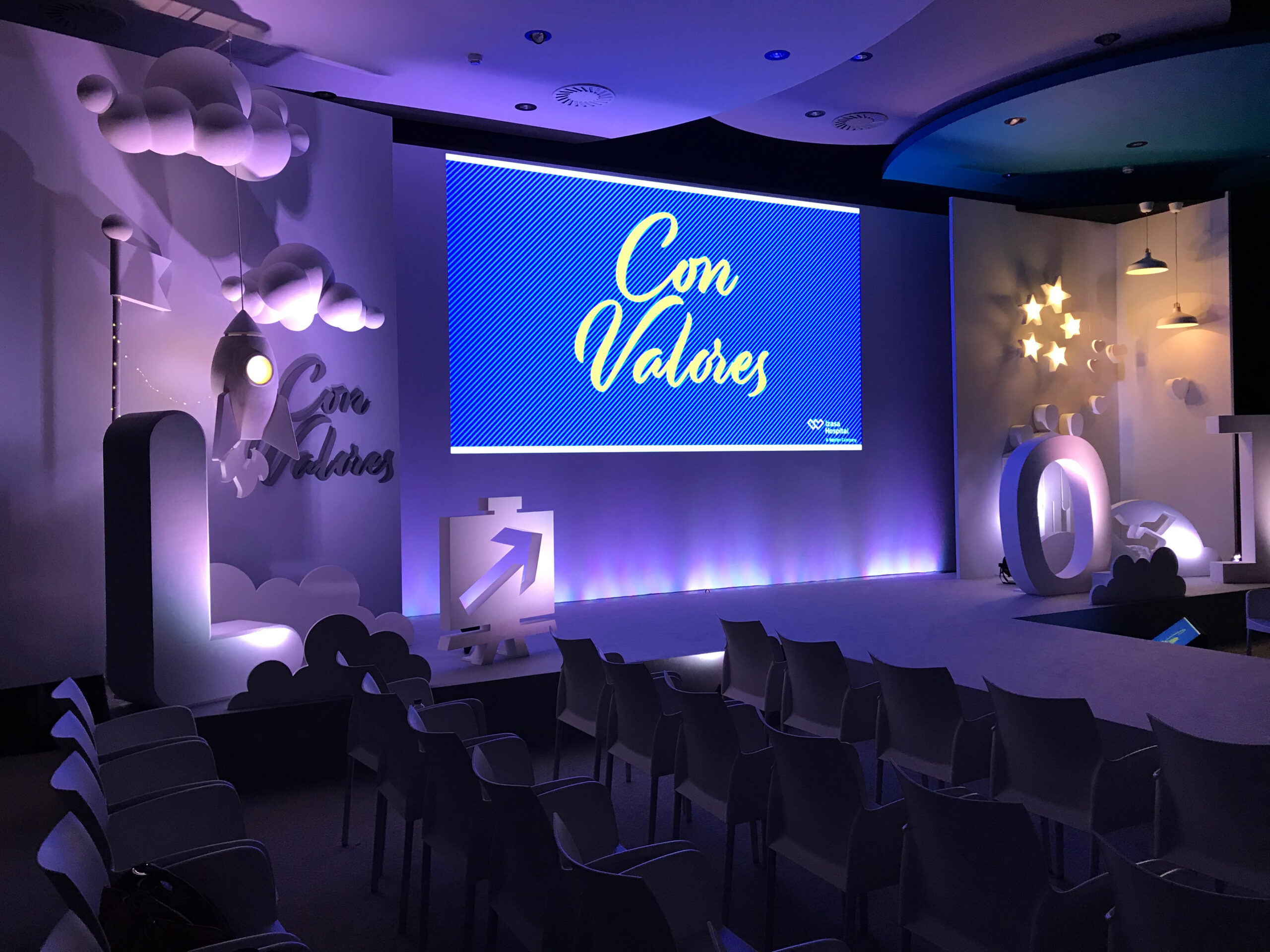
Screens vs. Scenography: Finding the Perfect Balance in Event Design
No one can deny that the technological revolution has transformed our sector for the better. High-resolution LED screens, the ability to change atmospheres with a single click, and the sheer spectacle of digital content have allowed us to create experiences that were unthinkable fifteen years ago.
However, in this race for visual spectacle, we must ask ourselves if we are falling into a dangerous inertia: the idea that “the bigger the screen, the better the event.” As professionals in event stage design and scenography, we believe the real challenge lies in achieving a perfect harmony between technology and physical structures.
1. The Biology of the Eye and Audience Attention
Cognitive science reminds us of a basic fact: the human eye is hardwired to chase light and movement.
When we place a speaker in front of a massive LED wall with constant motion graphics, we are asking the attendee’s brain to make an extra effort to ignore the most powerful stimulus (the screen) and focus on the subtle one (the human). This often leads to cognitive overload. The challenge isn’t adding more pixels; it’s managing event stage design and scenography so the speaker remains the true protagonist of the message.
2. In a Digital World, is Texture the New Luxury?
We spend our lives glued to digital devices—smartphones, laptops, and virtual meetings. When someone attends a live event in Barcelona or Madrid, what are they truly looking for?
Perhaps real connection today comes from seeing volume, matter, and real depth again. A well-designed physical scenography offers a visual “break” and a warmth that a screen, no matter its resolution, cannot replicate. Using bespoke woodwork and high-quality finishes provides a tactile, 3D experience that transforms a flat stage into a premium environment.
3. The Technical Harmony between Light and Video
Lighting designers know how difficult it is to correctly light a person when there is a massive light source right behind them. Often, the LED intensity “flattens” the subject, forcing aggressive front lighting to compensate.
A physical structure built in our in-house carpentry workshop allows us to play with shadows, create volumes, and model the space with light in a much more theatrical and emotional way. The goal is to find a middle ground where video supports the lighting rather than canceling it out.
4. Sustainability: Analyzing Energy and Material Efficiency
We often assume digital is “cleaner” because it avoids physical construction. However, when we look at the operational carbon footprint, the perspective shifts.
A large-format LED wall consumes a significant amount of energy throughout an event. In contrast, scenography based on modular aluminum systems (beMatrix) or FSC-certified timber has zero energy consumption once installed. At Saez Decom, we prioritize materials that can be reused or recycled, ensuring that our event stage design and scenography solutions are as eco-friendly as they are visually stunning.
Conclusion: Seeking Harmony in Stage Production
This is not about going back to the Stone Age or eliminating screens. They are indispensable tools in modern production.
Our proposal is simply to recover the balance. We imagine events where intelligently integrated screens coexist with physical structures that provide identity—where light, matter, and video dialogue to support the message, not to compete with it.
Looking for a balanced stage design?
Let’s work together to create a scenography that enhances your message without overwhelming your audience. Contact our creative team for your next event in Spain. Contact Our Scenographers.