
Event Production in Barcelona’s Historic Venues: The Technical Logistics Guide
During major trade shows like MWC or ISE, premium brands often host their gala dinners and private keynotes outside the main exhibition halls. They choose Barcelona’s stunning historic buildings.
Venues like the MNAC, Llotja de Mar, or the Palau de la Música Catalana offer breathtaking architecture. However, they also present massive logistical challenges for foreign production agencies.
You are not building a stand in an empty concrete hall anymore. You are working inside protected heritage sites. Therefore, standard event construction rules do not apply.
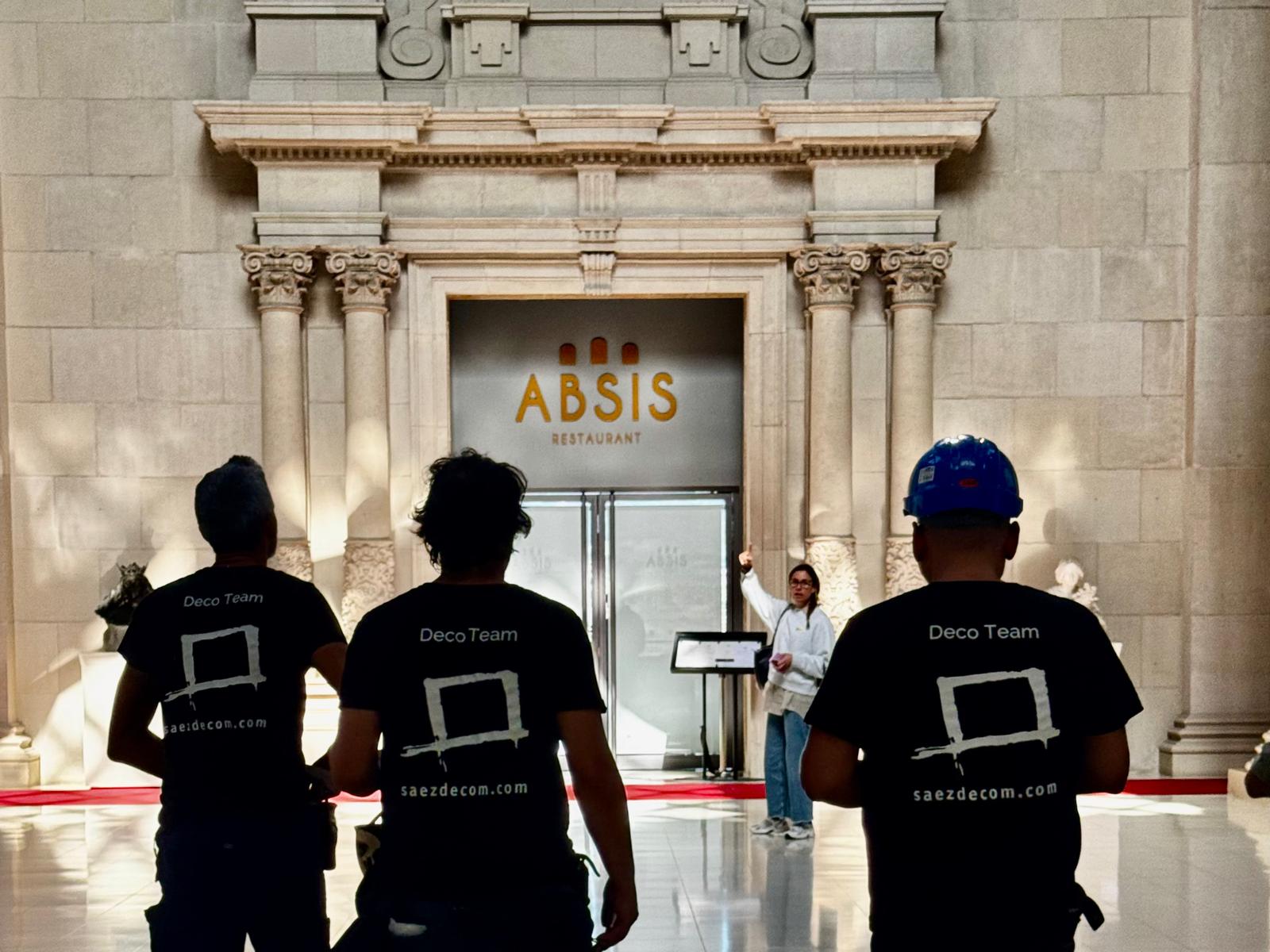
At Saez Decom, we have decades of experience building custom scenography and technical structures inside these exact buildings. Here is our insider guide to successfully managing event production in Barcelona’s historic venues without risking your deposit.
1. Floor Protection: The Non-Negotiable Rule
Historic venues have centuries-old flooring. A single scratch from a truss base plate can result in severe financial penalties.
The Rule: In venues like the MNAC (National Art Museum of Catalonia) and the Llotja de Mar, absolute floor protection is mandatory.
Our Process: We never place any structure directly on the original floor. First, we must install a complete layer of protective event carpet or technical flooring. Consequently, any heavy equipment, such as LED wall ground support or modular BeMatrix walls, is built safely on top of this protective layer.
2. City Center Access: The Truck Logistics Challenge
Transporting tonnes of AV and scenic equipment requires large trucks. However, historic buildings were not designed for modern logistics.
Palau de la Música Catalana & Llotja de Mar: Both venues are located right in the heart of Barcelona’s tight city center. Loading and unloading are highly complicated. There is minimal space for large trucks to maneuver or park.
The Solution: Precision timing is crucial. We use smaller, agile transport vehicles from our local fleet. Additionally, we coordinate exact drop-off windows to ensure the streets remain clear and the build-up continues without interruption.
3. Strict Schedules: Open Museums and Noise Limits
A historic venue is rarely just an event space. It is usually a functioning public institution or situated in a dense residential area.
Working Around the Public (MNAC): The MNAC has an excellent, large loading dock. However, build-up often happens while the museum is still open to the public. Therefore, we must implement strict safety cordons. Our crew operates silently and cleanly to avoid disturbing museum visitors.
Night Restrictions (Museu Marítim): The Maritime Museum offers much better ground-level access. However, it is located near residential zones. Consequently, loading and unloading during the night is strictly prohibited to avoid bothering the neighbors. Your production schedule must adapt to these daylight-only restrictions.
4. The Advantage of a Local Scenography Builder
When producing an event in a historic venue, you cannot rely on standard, bulky rental equipment shipped from across Europe. Doorways are narrow, and elevators are small.
You need custom-built solutions. With our own production workshops in both Barcelona and Madrid, we design and manufacture scenography specifically for these restrictive spaces. We pre-build the scenic elements in our facilities, bring them in manageable pieces, and assemble them swiftly on-site.
Summary: Protect the Heritage, Elevate the Event
Producing an unforgettable corporate event in a venue like the MNAC or Llotja de Mar requires deep local knowledge. Do not leave your logistics to chance.
Partner with a local technical constructor who understands the strict regulations of Barcelona’s heritage sites.
Planning a premium event in a historic Spanish venue? Contact Saez Decom today. Let our technical directors manage your scenography, structures, and logistics safely.